Artificial Intelligence
Artificial Intelligence (AI) is a branch of computer science that enables machines and software to perform tasks that normally require human intelligence. These tasks include learning from data, solving problems, understanding language, recognizing images, making decisions, and improving performance through experience.
Today, AI is used in smartphones, search engines, healthcare, banking, education, transportation, manufacturing, and entertainment. Virtual assistants like Siri and Google Assistant, recommendation systems on YouTube and Netflix, and chatbots are all examples of AI in everyday life.
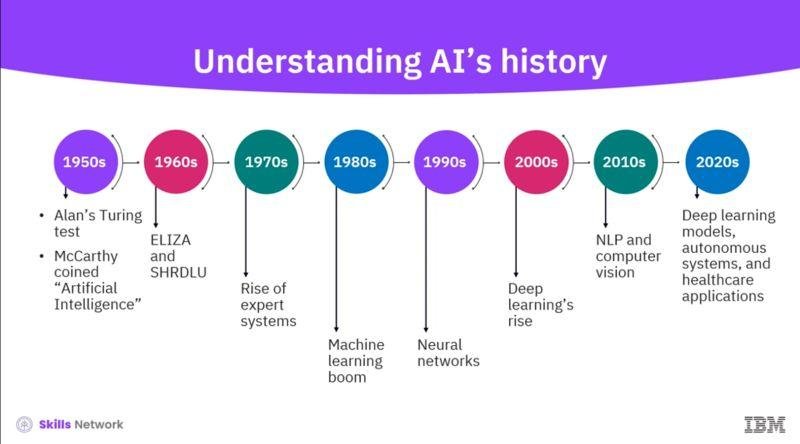
History of Artificial Intelligence
The concept of intelligent machines has existed for centuries, but modern AI began in the 20th century.
1943
Warren McCulloch and Walter Pitts introduced the first mathematical model of artificial neurons.
1950
Alan Turing proposed the famous Turing Test, a method for determining whether a machine can exhibit intelligent behavior similar to humans.
1956
The term Artificial Intelligence was officially introduced by John McCarthy at the Dartmouth Conference. This event is considered the birth of AI as an academic field.
1960s–1970s
Researchers developed programs capable of solving mathematical problems and playing simple games.
1980s
Expert systems became popular in business and medicine because they could imitate the decision-making ability of human experts.
1997
IBM’s Deep Blue defeated world chess champion Garry Kasparov, marking a major milestone in AI.
2010s
The rise of big data, cloud computing, and powerful GPUs accelerated AI development through machine learning and deep learning.
Today
AI powers self-driving cars, healthcare diagnosis, language translation, robotics, cybersecurity, smart assistants, and generative AI systems.
How Artificial Intelligence Works
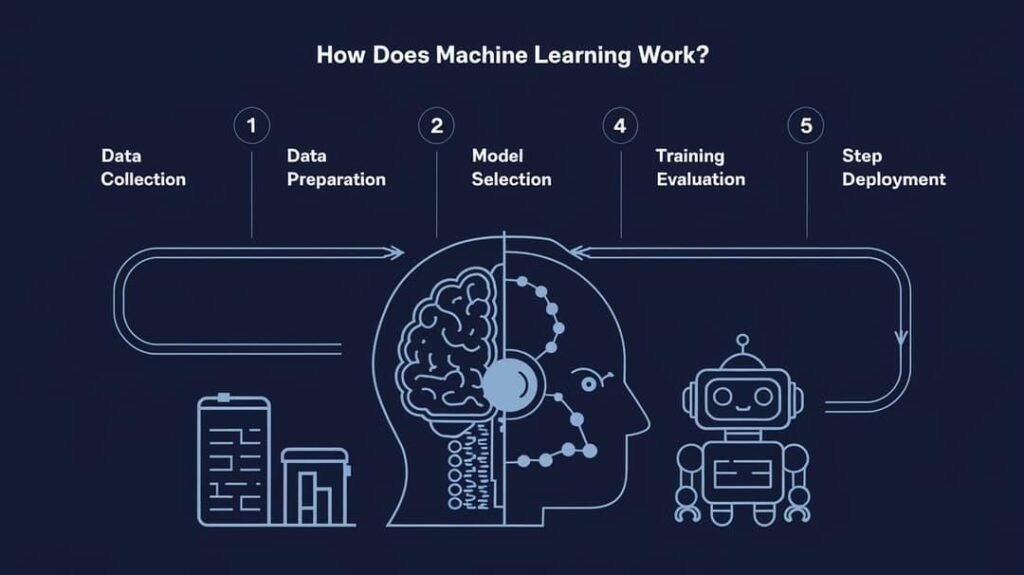
Artificial Intelligence works by collecting and analyzing data to identify patterns and make predictions or decisions.
Step 1: Data Collection
AI systems gather information from images, videos, text, sensors, and databases.
Step 2: Data Processing
The collected data is cleaned and organized for training.
Step 3: Model Training
Machine learning algorithms learn from the data and recognize patterns.
Step 4: Decision Making
The trained model predicts outcomes or makes decisions based on new information.
Step 5: Continuous Learning
Many AI systems improve over time as they receive additional data and feedback.
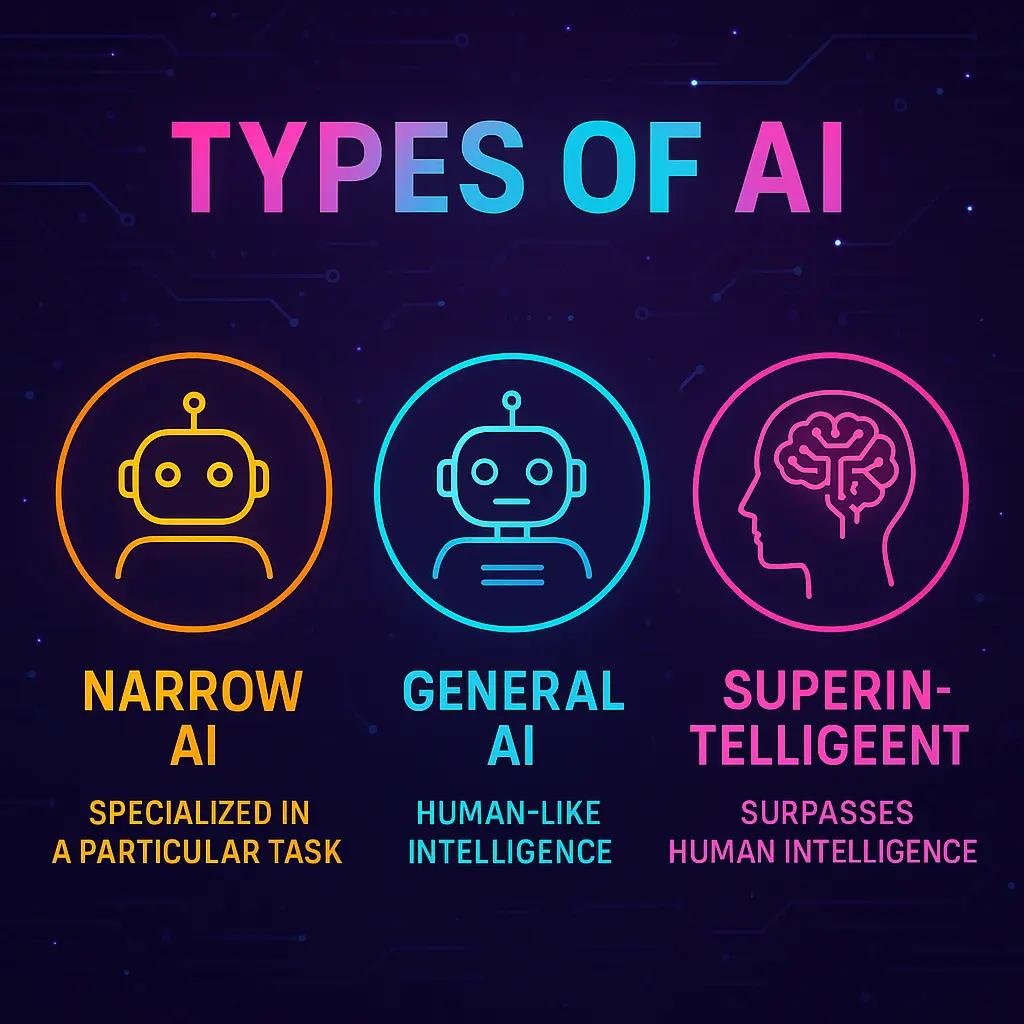
Types of Artificial Intelligence
1. Narrow AI (Weak AI)
Designed for a single task such as voice assistants, recommendation systems, or spam detection.
Examples
- Siri
- Google Assistant
- Netflix Recommendations
2. General AI (Strong AI)
A theoretical AI capable of performing any intellectual task that humans can do. It has not yet been achieved.
3. Super AI
A hypothetical future AI that would surpass human intelligence in creativity, reasoning, and problem-solving.
Based on Functionality
Reactive Machines
Respond only to current situations without memory.
Limited Memory AI
Uses past information to improve decisions.
Theory of Mind AI
A future concept where AI understands emotions and intentions.
Self-Aware AI
A hypothetical AI possessing consciousness and self-awareness.
What is Artificial Intelligence (AI)?
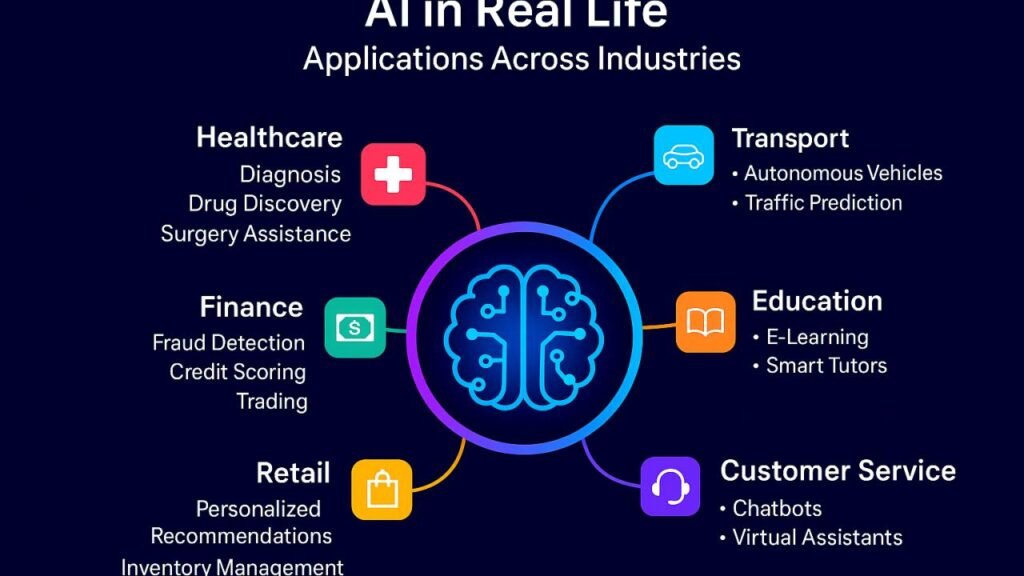
Artificial Intelligence is transforming many industries.
Healthcare
- Disease diagnosis
- Medical imaging
- Drug discovery
- Patient monitoring
Education
- Smart tutoring systems
- Personalized learning
- Automated grading
Finance
- Fraud detection
- Credit scoring
- Algorithmic trading
Transportation
- Self-driving vehicles
- Traffic management
- Route optimization
Retail
- Product recommendations
- Customer service chatbots
- Inventory management
Agriculture
- Crop monitoring
- Smart irrigation
- Pest detection
Manufacturing
- Predictive maintenance
- Quality control
- Industrial robots
Cybersecurity
- Threat detection
- Malware analysis
- Network monitoring
Entertainment
- Movie recommendations
- Music suggestions
- AI-generated content
Advantages of Artificial Intelligence
- Automates repetitive tasks
- Reduces human error
- Improves productivity
- Works 24/7 without fatigue
- Provides faster decision-making
- Enhances healthcare diagnosis
- Improves customer service
- Supports scientific research
- Increases business efficiency
- Handles large volumes of data quickly
Disadvantages of Artificial Intelligence
- High development and maintenance costs
- Potential job displacement
- Privacy concerns
- Cybersecurity risks
- Bias in AI models
- Lack of human emotions and creativity
- Dependence on quality data
- Ethical concerns
- Possibility of misuse
- Requires significant computing resources
- What is Artificial Intelligence (AI)?
Future of Artificial Intelligence
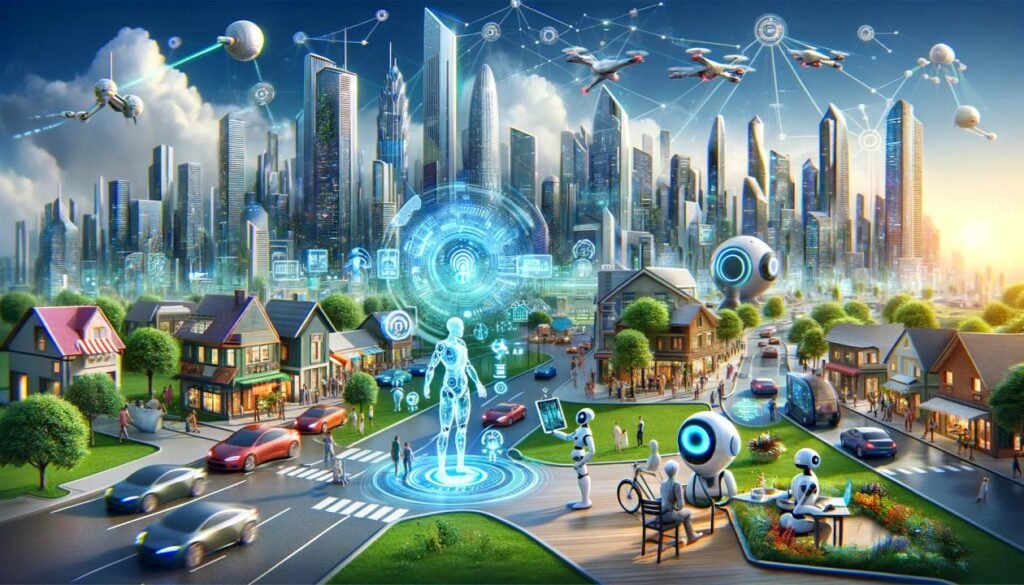
The future of AI is expected to bring significant advancements across industries. AI will improve healthcare through faster diagnosis and personalized treatments, enhance education with adaptive learning systems, and transform transportation with safer autonomous vehicles. Businesses will rely more on AI for automation, customer support, and decision-making. Robotics, smart cities, precision agriculture, and scientific research will continue to benefit from AI technologies. At the same time, governments and organizations will focus on developing ethical guidelines, improving transparency, and ensuring responsible AI use. AI is expected to become an even more important part of daily life while working alongside humans to solve complex global challenges.
Conclusion
What is Artificial Intelligence (AI)?
Artificial Intelligence is one of the most influential technologies of the modern era. From healthcare and education to finance and transportation, AI is transforming the way people live and work. Although AI offers numerous benefits, it also presents challenges related to ethics, privacy, and employment. By developing and using AI responsibly, society can maximize its advantages while minimizing potential risks.
10 SEO Tags
- Artificial Intelligence
- What is AI
- History of Artificial Intelligence
- Types of AI
- AI Applications
- Advantages of AI
- Disadvantages of AI
- Future of Artificial Intelligence
- Machine Learning
- AI Technology
Important YouTube Lecture Videos
- Harvard University – CS50 Introduction to Artificial Intelligence
https://www.youtube.com/results?search_query=CS50+Introduction+to+Artificial+Intelligence - freeCodeCamp – Artificial Intelligence Full Course
https://www.youtube.com/results?search_query=freeCodeCamp+Artificial+Intelligence+Full+Course - Simplilearn – Artificial Intelligence Tutorial
https://www.youtube.com/results?search_query=Simplilearn+Artificial+Intelligence - Great Learning – Artificial Intelligence Course
https://www.youtube.com/results?search_query=Great+Learning+Artificial+Intelligence - Google Developers – AI & Machine Learning
https://www.youtube.com/results?search_query=Google+Developers+Artificial+Intelligence - MIT OpenCourseWare – Artificial Intelligence
https://www.youtube.com/results?search_query=MIT+OpenCourseWare+Artificial+Intelligence - Stanford Online – AI Lectures
https://www.youtube.com/results?search_query=Stanford+Artificial+Intelligence+Lectures - IBM Technology – AI Explained
https://www.youtube.com/results?search_query=IBM+Technology+Artificial+Intelligence - Microsoft Developer – AI Learning
https://www.youtube.com/results?search_query=Microsoft+Artificial+Intelligence - Coursera AI Courses Overview
https://www.youtube.com/results?search_query=Coursera+Artificial+Intelligence