 by
by SHEHBAZ SHARIF
From the Sharif Business Family to the Prime Minister’s Office
Mian Muhammad Shehbaz Sharif is one of the most prominent political figures in Pakistan’s modern history. His journey from the industrial Sharif family of Lahore to the highest elected office in the country spans decades of provincial politics, opposition, political crises, administrative reforms, family political struggles and two separate periods as Prime Minister of Pakistan.
Born on 23 September 1951 in Lahore, Shehbaz Sharif is the son of industrialist Mian Muhammad Sharif and the younger brother of former Prime Minister Nawaz Sharif. His early life was closely connected with the Sharif family’s industrial and business background before he entered active politics.
His political career would eventually make him one of the longest-serving Chief Ministers of Punjab and later Prime Minister of Pakistan.
THE BEGINNING
FAMILY, BUSINESS & EARLY POLITICAL LIFE
Shehbaz Sharif was born into the Sharif family, a prominent business family based in Lahore.
The family’s industrial interests became closely associated with the Ittefaq Group, which grew into one of Pakistan’s well-known industrial groups.
Before reaching the highest levels of politics, Shehbaz was involved in the family’s business activities.
His entry into politics occurred during a period of major political transformation in Pakistan.
His elder brother, Nawaz Sharif, was already emerging as a major political figure, and the Sharif family’s political influence was growing particularly strongly in Punjab.
Shehbaz eventually became an important member of the Pakistan Muslim League-Nawaz (PML-N).
1988
ENTERING PARLIAMENTARY POLITICS
Shehbaz Sharif entered electoral politics in the late 1980s.
He was elected to the Punjab Provincial Assembly and also entered the National Assembly.
His political career developed rapidly alongside that of his brother Nawaz Sharif.
Unlike Nawaz, who became the central national political face of PML-N, Shehbaz increasingly developed a reputation for administration, organization and implementation.
This distinction would later become one of the defining characteristics of his political identity.
1990s
RISING THROUGH PUNJAB POLITICS
During the 1990s, Shehbaz Sharif became increasingly influential within PML-N.
When Nawaz Sharif became Prime Minister, Shehbaz’s political responsibilities grew.
In February 1997, Shehbaz Sharif became Chief Minister of Punjab for the first time.
The official Punjab government record lists his first tenure from 20 February 1997 to 12 October 1999.
His first government focused heavily on administration, infrastructure and development.
But his tenure was abruptly interrupted by the military coup of 12 October 1999, when General Pervez Musharraf removed Nawaz Sharif’s government.
The Sharif family entered a new period of political uncertainty.
1999
THE MILITARY COUP & EXILE
The military takeover dramatically changed Shehbaz Sharif’s political life.
Nawaz Sharif was removed as Prime Minister, while members of the Sharif family faced political and legal pressure.
Shehbaz Sharif eventually left Pakistan and spent years in exile, particularly in Saudi Arabia.
During this period, the Sharif family maintained its political organization and continued to oppose military rule.
Shehbaz remained an important figure within PML-N even while outside Pakistan.
2007–2008
RETURN TO PAKISTAN
The political landscape changed following the return of the Sharif family to Pakistan.
Shehbaz Sharif returned to active politics and participated in the rebuilding of PML-N.
The 2008 general election brought PML-N back into a significant political position, particularly in Punjab.
Shehbaz’s administrative career was about to enter its most influential phase.
2008
THE RETURN TO THE PUNJAB GOVERNMENT
In June 2008, Shehbaz Sharif became Chief Minister of Punjab for the second time.
The Punjab government’s official records list his tenure from 8 June 2008 to 27 March 2013.
His second period as Chief Minister established the political image for which he became particularly well known:
Speed of execution.
Infrastructure development.
Administrative monitoring.
Public-service delivery.
Education initiatives.
Healthcare projects.
Transport development.
He frequently visited project sites, held administrative meetings and publicly demanded faster implementation from government officials.
This highly interventionist style became a defining part of the “Punjab model” associated with his administration.
THE METROBUS ERA
One of the most visible symbols of Shehbaz Sharif’s Punjab administration was the development of mass-transit systems.
The Lahore Metrobus became a major urban transport project and was presented by the Punjab government as an effort to provide affordable and efficient public transportation.
Later, similar mass-transit projects were developed in other Punjab cities.
Supporters viewed these projects as evidence of rapid infrastructure development.
Critics questioned project costs, procurement processes and the government’s preference for large infrastructure projects.
Nevertheless, transport infrastructure became one of the most recognizable elements of Shehbaz Sharif’s administrative legacy.
EDUCATION & HEALTHCARE
During his Punjab governments, Shehbaz Sharif placed considerable emphasis on education and healthcare.
His administrations promoted initiatives aimed at expanding access to schools, scholarships and educational opportunities.
Healthcare projects and hospital improvements were also highlighted as major government priorities.
The broader political message was clear:
Government performance should be visible to ordinary citizens.
This approach helped Shehbaz develop a reputation as an administrator who preferred measurable and highly visible projects.
2013
ANOTHER TERM AS CHIEF MINISTER
After PML-N won the 2013 general election and Nawaz Sharif became Prime Minister for the third time, Shehbaz Sharif continued to lead Punjab.
He began another five-year period as Chief Minister in June 2013.
The official Punjab record lists his tenure from 7 June 2013 to 7 June 2018.
During this period, his administration expanded major infrastructure and transport projects.
The Punjab government also promoted education, healthcare, agriculture, energy and urban development initiatives.
Shehbaz became increasingly recognized nationally as a politician with a strong administrative and managerial style.
CPEC & INFRASTRUCTURE
Shehbaz’s political career coincided with the expansion of the China-Pakistan Economic Corridor (CPEC).
Large infrastructure and energy projects became central to the PML-N government’s development narrative.
Roads, power projects, transport systems and urban infrastructure formed a major part of the political image associated with the Sharif governments.
Supporters argued that these projects improved connectivity and addressed long-standing infrastructure deficiencies.
Critics raised questions about costs, debt, transparency and the long-term economic benefits of some projects.
The debate surrounding development versus fiscal sustainability became an important part of Shehbaz Sharif’s political legacy.
2017–2018
THE SHARIF FAMILY CRISIS
The political situation changed dramatically in 2017, when Nawaz Sharif was removed from office following the Supreme Court’s decision related to the Panama Papers case.
PML-N faced one of the most difficult periods in its history.
Shehbaz Sharif increasingly emerged as one of the party’s central leaders.
After Nawaz Sharif’s disqualification, Shehbaz became particularly important in maintaining the party’s organizational structure and political presence.
2018
FROM PUNJAB TO NATIONAL LEADERSHIP
After the 2018 general election, PML-N moved into opposition.
Shehbaz Sharif became Leader of the Opposition in the National Assembly.
This was a major transformation.
For years, he had been primarily identified with Punjab administration.
Now he became the principal parliamentary opposition leader at the federal level.
He faced the government of Imran Khan and increasingly became one of its strongest political opponents.
2019–2021
OPPOSITION & LEGAL BATTLES
During the PTI government, Shehbaz Sharif faced several corruption and accountability cases.
He was arrested by the National Accountability Bureau in 2018 in the Ashiana Housing case and later faced other proceedings.
Shehbaz and PML-N rejected allegations of corruption and maintained that accountability proceedings were politically motivated.
Several cases continued through the courts for years.
A professional biography should distinguish between allegations, arrests, convictions and final judicial outcomes, rather than presenting accusations as proven facts.
2022
THE POLITICAL TURNING POINT
The most important chapter of Shehbaz Sharif’s political career came in April 2022.
After a prolonged political confrontation, Prime Minister Imran Khan’s government lost a parliamentary vote of no confidence.
On 11 April 2022, Shehbaz Sharif was elected Prime Minister of Pakistan.
The National Assembly’s official record confirms that he received 174 votes in the 2022 election for Prime Minister.
For Shehbaz, this was the culmination of decades of provincial and national politics.
The administrator of Punjab had finally reached the Prime Minister’s Office.
THE FIRST PREMIERSHIP
2022–2023
Shehbaz Sharif’s first federal government was a coalition made up of multiple political parties.
The government inherited major economic difficulties, including:
High inflation
Foreign-exchange pressure
Energy challenges
Fiscal constraints
External financing requirements
Political polarization
The government faced the difficult task of managing the economy while simultaneously dealing with intense opposition from PTI.
Shehbaz’s administration also worked with international financial institutions and friendly countries to stabilize Pakistan’s external finances.
THE FLOODS OF 2022
One of the earliest major crises faced by Shehbaz Sharif’s government was the catastrophic 2022 floods.
Large parts of Pakistan were affected by extreme flooding, causing enormous losses to homes, agriculture, infrastructure and livelihoods.
The federal government launched relief and reconstruction efforts while appealing internationally for assistance.
Shehbaz Sharif also raised the issue of climate-related vulnerability at international forums.
The floods became one of the defining humanitarian challenges of his first premiership.
ECONOMIC PRESSURE
Shehbaz Sharif’s first government faced severe economic challenges.
The country struggled with inflation, foreign-exchange shortages and pressure on its external financing position.
The government pursued measures aimed at securing financial assistance and stabilizing the economy.
These measures were politically difficult because they included reforms and adjustments that affected consumers and businesses.
Supporters argued that the government inherited an extremely difficult economic situation.
Critics blamed the coalition government for economic mismanagement and rising inflation.
The economic debate remains one of the most important parts of Shehbaz Sharif’s record as Prime Minister.
2023
THE END OF THE FIRST TERM
Shehbaz Sharif remained Prime Minister until 14 August 2023.
His government completed its constitutional period and transitioned to a caretaker administration before the next general election.
The National Assembly’s official record lists his first premiership from 11 April 2022 to 14 August 2023.
Anwaar-ul-Haq Kakar subsequently became caretaker Prime Minister.
Shehbaz returned to opposition politics and PML-N’s election campaign.
2024
THE SECOND RETURN TO POWER
The 8 February 2024 general election produced a fragmented parliamentary landscape.
PML-N became one of the major parliamentary parties and subsequently formed a coalition government with allied parties.
On 3 March 2024, Shehbaz Sharif was elected Prime Minister for the second time.
The National Assembly officially recorded that he secured 201 votes against Omar Ayub Khan’s 92 votes.
His return marked another extraordinary chapter in a political career that had already lasted decades.
SHEHBAZ SHARIF TODAY
THE SECOND PREMIERSHIP
As of 2026, Shehbaz Sharif remains the Prime Minister of Pakistan.
The National Assembly’s current profile identifies him as Mian Muhammad Shehbaz Sharif, representing NA-123 Lahore-VII and affiliated with PML-N.
His second government continues to focus heavily on:
Economic stabilization
Investment
Energy
Infrastructure
Privatization and state-owned enterprises
Digital transformation
Agriculture
Foreign investment
Relations with China and Gulf states
International financial cooperation
His government also faces the continuing challenges of inflation, public debt, energy costs, political polarization and economic reform.
THE SHEHBAZ SHARIF POLITICAL STYLE
Shehbaz Sharif has developed a political identity different from that of his elder brother.
Nawaz Sharif has often been associated with national political vision, political confrontation and major strategic decisions.
Shehbaz has built his reputation around administration and execution.
His political style is often characterized by:
SPEED
A strong emphasis on rapid completion of government projects.
MONITORING
Frequent administrative reviews and direct oversight.
INFRASTRUCTURE
Roads, transport systems, public buildings and development projects.
SERVICE DELIVERY
Education, healthcare and welfare programmes.
MANAGERIAL POLITICS
A focus on government performance and implementation.
This style made him particularly powerful in Punjab and later shaped his approach to federal government.
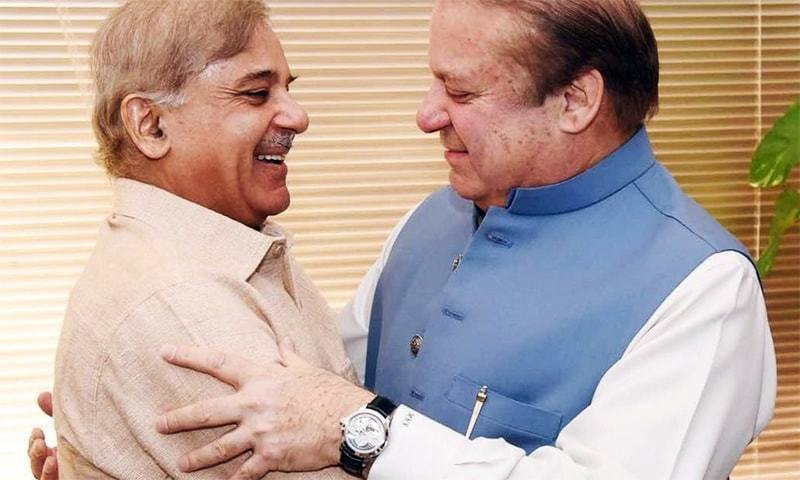
THE SHARIF BROTHERS
TWO DIFFERENT POLITICAL ROLES
The political history of Shehbaz Sharif cannot be separated from his relationship with Nawaz Sharif.
The two brothers have remained central figures in PML-N for decades.
Nawaz Sharif became the party’s principal national leader.
Shehbaz developed a reputation as the party’s administrator and organizational manager.
Their political partnership survived military rule, exile, electoral defeats, legal cases and changes of government.
The Sharif family’s political influence remains one of the defining features of Pakistani politics.
CONTROVERSIES & ACCOUNTABILITY
Shehbaz Sharif’s career has also been accompanied by numerous allegations and accountability proceedings.
His critics have accused him and his political network of corruption, favoritism and misuse of public resources.
Shehbaz Sharif has consistently denied wrongdoing.
Several high-profile cases against him have produced different legal outcomes, including acquittals and closures.
For a credible website biography, it is essential to distinguish between:
ALLEGATION
INVESTIGATION
ARREST
CHARGE
CONVICTION
ACQUITTAL
These are legally different categories and should never be presented as interchangeable.
THE DEVELOPMENT LEGACY
Shehbaz Sharif’s strongest political legacy has traditionally been connected with development and administration.
During his long periods as Punjab Chief Minister, he became associated with:
Metrobus systems
Road infrastructure
Education programmes
Healthcare projects
Urban development
Energy initiatives
Public transport
Administrative monitoring
The Punjab government’s official records confirm that he served as Chief Minister during three separate periods: 1997–1999, 2008–2013 and 2013–2018.
These years established the administrative reputation that later became central to his national political identity.
THE JOURNEY IN NUMBERS
1951
Born in Lahore
1980s
Entered electoral politics
1997
First became Chief Minister of Punjab
1999
Removed from provincial power following the military coup
2008
Returned as Chief Minister of Punjab
2013
Began another five-year term as Punjab Chief Minister
2018
Became Leader of the Opposition in the National Assembly
2022
Became Prime Minister for the first time
2023
Left office after completion of the parliamentary term
2024
Returned as Prime Minister for the second time
2026
Continues to serve as Prime Minister of Pakistan
THE LEGACY
Shehbaz Sharif’s political legacy remains a subject of intense debate.
His supporters see him as a hands-on administrator, a development-focused leader and a politician capable of managing complex government machinery.
His critics point to economic difficulties, political polarization, governance controversies and allegations surrounding the broader Sharif political network.
His career nevertheless demonstrates remarkable political endurance.
He survived military rule.
He spent years outside Pakistan.
He returned to provincial power.
He became one of Pakistan’s longest-serving Chief Ministers of Punjab.
He became Leader of the Opposition.
He became Prime Minister.
He lost the office.
And then he returned to the Prime Minister’s Office again.
FROM LAHORE TO ISLAMABAD
Shehbaz Sharif’s journey is ultimately a story of political persistence and administrative ambition.
From the industrial environment of the Sharif family to the Punjab Assembly.
From Punjab’s Chief Minister’s Office to the National Assembly.
From opposition politics to the Prime Minister’s Office.
From political crisis to political comeback.
His career has been shaped by power, development, family politics, institutional conflict, economic challenges and political resilience.
THE JOURNEY CONTINUES
From the Sharif family business to Punjab’s highest office.
From Punjab’s Chief Minister to Leader of the Opposition.
From opposition politics to Prime Minister of Pakistan.
From political defeat to another return to power.
Shehbaz Sharif’s story is one of the longest-running political journeys in contemporary Pakistan — and the next chapter is still being written from Islamabad.