 by
by IMRAN KHAN
From Cricket Legend to Political Leader
Born: 5 October 1952 — Lahore, Pakistan
Profession: Cricketer • Philanthropist • Politician
Cricket Career: 1971–1992
Political Party: Pakistan Tehreek-e-Insaf (PTI)
Prime Minister of Pakistan: 2018–2022
THE EARLY YEARS
Imran Ahmed Khan Niazi was born in Lahore on 5 October 1952. He grew up in a family with strong connections to cricket. His maternal relatives included Test cricketers, while his own early education took place at institutions including Aitchison College in Lahore.
His cricketing journey developed further in England, where he attended the Royal Grammar School Worcester and later studied at Keble College, Oxford, graduating in 1975 after studying Philosophy, Politics and Economics.
Cricket, however, was already becoming the defining force of his life.
THE CRICKETER WHO ROSE TO THE TOP
Imran Khan made his first-class debut in 1970 and made his Test debut for Pakistan against England at Edgbaston in June 1971.
The beginning was not spectacular. His early international appearances were interrupted by his studies, but he gradually developed into a powerful fast bowler and complete all-rounder.
His breakthrough came during Pakistan’s tour of Australia and the West Indies in 1976–77. In the Sydney Test, he took 12 wickets in the match, while on the Caribbean tour he claimed 25 wickets in the series.
These performances established him as one of Pakistan’s premier fast bowlers.
The following years transformed him from a talented cricketer into an international superstar.
THE GOLDEN ERA
During the 1980s, Imran Khan became one of the world’s leading all-rounders.
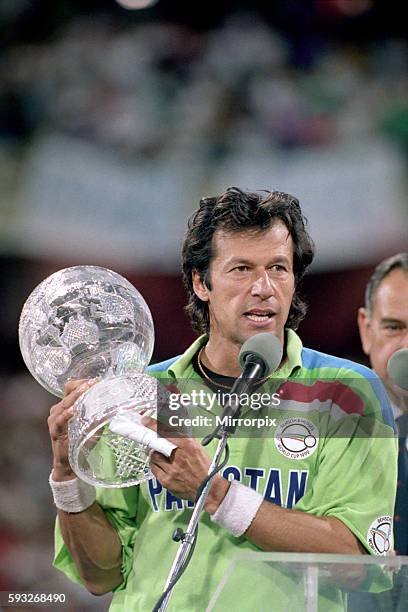
He was a right-handed batsman and right-arm fast bowler, capable of influencing matches with both bat and ball. In 1982, he took 40 wickets in Pakistan’s six-Test home series against India.
His career was also interrupted by injury. A stress fracture of the shin kept him away from bowling for a significant period, but he returned to international cricket and continued to perform at the highest level.
In 1982, he became captain of Pakistan.
Under his leadership, Pakistan became a much more competitive force in international cricket. He led the team through the 1980s, including the 1987 World Cup, where Pakistan reached the semi-finals.
1992 — THE MOMENT THAT CHANGED EVERYTHING
THE WORLD CUP TRIUMPH
The defining moment of Imran Khan’s sporting career came in 1992.
Pakistan entered the World Cup in Australia and New Zealand with an inconsistent start. The team then recovered dramatically and reached the final against England at the Melbourne Cricket Ground.
Imran Khan scored 72 runs in the final and played a central role in Pakistan’s victory.
Pakistan defeated England by 22 runs and won the country’s first-ever Cricket World Cup.
For Imran Khan, it was the final chapter of an extraordinary cricket career.
He retired from international cricket later that year.
The ICC describes him as one of the greatest all-rounders to have played the game. He finished his international career with 88 Test matches and 175 ODIs, including 362 Test wickets and 182 ODI wickets.
1992
WORLD CUP CHAMPION
A captain.
An all-rounder.
A national icon.
A moment that became part of Pakistan’s sporting history.
BEYOND CRICKET
A PERSONAL LOSS THAT BECAME A NATIONAL MISSION
Imran Khan’s life after cricket was not simply about politics.
In 1985, his mother, Shaukat Khanum, died from cancer. During her illness, Khan witnessed the difficulties faced by cancer patients, particularly those who could not afford treatment.
That experience eventually became one of the most important humanitarian projects associated with his name.
He began raising money for a cancer hospital in Pakistan.
The fundraising campaign faced major financial and practical obstacles. Khan appealed to ordinary Pakistanis, including schoolchildren, and organized extensive fundraising campaigns.
In December 1994, the Shaukat Khanum Memorial Cancer Hospital and Research Centre in Lahore opened its doors.
The hospital was established with the goal of providing cancer treatment regardless of a patient’s ability to pay. The organization says the Lahore centre has continued to provide completely free treatment to more than 75% of its cancer patients.
1994
SHAUKAT KHANUM MEMORIAL CANCER HOSPITAL
What began as a personal tragedy became a nationwide philanthropic project.
THE EDUCATION MISSION
NAMAL
Imran Khan later turned his attention toward education.
According to Namal University’s official history, the idea began in 2005, with the vision of creating an institution that could provide educational opportunities for young people in Pakistan.
Namal College was established in 2008 and initially operated as an affiliate college of the University of Bradford in the United Kingdom.
In 2019, Namal received degree-awarding status and became Namal Institute. The broader vision subsequently developed into the planned Namal Knowledge City.
For Khan, the project represented another attempt to build an institution that could create opportunities beyond the major urban centres of Pakistan.
THE POLITICAL JOURNEY
1996 — A NEW BEGINNING
Four years after winning the World Cup, Imran Khan entered Pakistani politics.
On 25 April 1996, he founded Pakistan Tehreek-e-Insaf (PTI) in Lahore.
The early years were difficult.
PTI performed poorly in the 1997 general election, and Khan’s political ambitions were initially treated with considerable skepticism.
But he continued to build the party.
In the 2002 general election, Khan won a National Assembly seat from Mianwali, becoming a member of parliament for the first time.
2011 — THE POLITICAL BREAKTHROUGH
A major transformation came in 2011.
PTI’s Lahore rally attracted tens of thousands of people and demonstrated that Khan had developed a significant political following.
The party increasingly positioned itself around themes including:
Anti-corruption
Rule of law
Merit
Institutional reform
Social welfare
Accountability
Reuters reported that Khan’s 2011 Lahore rally focused heavily on corruption and his pledge to pursue political reform.
The political movement that had once seemed marginal was becoming a major force in Pakistani politics.
2013 — PTI BECOMES A MAJOR POLITICAL FORCE
In the 2013 general election, PTI emerged as one of Pakistan’s major political parties.
Although it did not form the federal government, the election established PTI as a serious national political force.
Khan continued to campaign for political reform and accountability while strengthening the party’s organizational structure.
2018 — THE ROAD TO POWER
The next major chapter came in 2018.
PTI won the largest number of National Assembly seats in the general election and subsequently formed a coalition government.
On 17 August 2018, Imran Khan was elected Prime Minister by the National Assembly.
He took the oath of office on 18 August 2018, becoming the 22nd Prime Minister of Pakistan.
For a man who had entered politics in 1996 with little conventional political experience, reaching the country’s highest elected executive office represented a remarkable transformation.
THE PRIME MINISTER YEARS
2018–2022
As Prime Minister, Khan presented his political vision under the idea of “Naya Pakistan” — a Pakistan based on stronger institutions, social welfare, accountability and economic reform.
His government launched and expanded a number of major programmes and initiatives.
EHSAAS PROGRAMME
Launched in March 2019, Ehsaas became the government’s flagship social-protection programme.
The government described it as Pakistan’s largest social protection and poverty-reduction initiative, covering a wide range of programmes including cash assistance, scholarships, nutrition support and interest-free loans.
HEALTHCARE
The Sehat Sahulat Programme was expanded during Khan’s period in government as part of a broader effort toward wider health coverage. The programme provided access to healthcare services through public and private hospitals for eligible beneficiaries.
ENVIRONMENT
Khan’s government also promoted large-scale environmental programmes, including the Ten Billion Tree Tsunami initiative, building upon earlier provincial tree-planting efforts.
INTERNATIONAL DIPLOMACY
During his premiership, Khan became an outspoken international advocate on issues including Islamophobia, Kashmir, Afghanistan and relations between developed and developing countries.
He raised the issue of Islamophobia repeatedly at international forums and called for greater interfaith understanding.
At the United Nations General Assembly in 2019 and 2021, he spoke extensively about Islamophobia, Kashmir, Afghanistan, poverty and global inequality.
THE FALL OF HIS GOVERNMENT
10 APRIL 2022
Imran Khan’s premiership ended on 10 April 2022.
The National Assembly passed a no-confidence motion against him after opposition parties and former coalition allies assembled enough support to remove his government.
Khan became the first Pakistani prime minister to leave office through a successful parliamentary no-confidence vote.
After his removal, Khan launched a major political campaign demanding early elections.
He also alleged that his government had been removed through a foreign-backed conspiracy. The United States and Pakistani officials rejected the allegation.
THE ATTACK
NOVEMBER 2022
On 3 November 2022, while leading a political protest convoy in Punjab, Imran Khan was shot and injured.
He survived the attack and continued his political campaign.
The incident became another defining moment in the increasingly tense political confrontation between Khan, his supporters and the government.
ARREST AND LEGAL BATTLES
2023 — A NEW AND DIFFICULT CHAPTER
On 9 May 2023, Imran Khan was arrested while appearing for a hearing at the Islamabad High Court.
His arrest triggered widespread protests and violent unrest in Pakistan. The government subsequently launched extensive legal proceedings against Khan and PTI leaders and supporters.
In August 2023, Khan was arrested again after being convicted in the Toshakhana case.
From this point onward, his political life became closely intertwined with a large number of criminal and civil cases.
Khan and PTI have repeatedly argued that many of the cases are politically motivated. The authorities have rejected that characterization.
THE LEGAL CASES
A STORY THAT REQUIRES CONTEXT
Imran Khan has faced more than 100 legal cases across different proceedings.
However, it is important not to describe every case as a conviction.
Some convictions have been overturned, some sentences suspended, some cases have ended in acquittal, while other proceedings remain ongoing.
For example, in June 2024, the Islamabad High Court overturned Khan’s conviction in the state-secrets/cipher case. He nevertheless remained imprisoned because of other cases.
In another case concerning his marriage, Khan and Bushra Bibi were sentenced in 2024, but they were later acquitted in that case.
The legal history therefore remains complicated and should be presented carefully rather than reducing it to a single political narrative.
2024 — POLITICS WITHOUT KHAN
Pakistan held general elections in February 2024 while Imran Khan remained imprisoned.
PTI candidates faced restrictions and contested largely as independents after the party’s electoral symbol was removed.
Despite Khan’s imprisonment, candidates backed by PTI won a large number of National Assembly seats.
Because no party secured a majority sufficient to govern alone, a coalition government was formed by rival parties.
Khan continued to maintain that the election process had not reflected the genuine mandate of his supporters.
2025–2026 — IMPRISONMENT AND CONTINUING POLITICAL INFLUENCE
The years after the 2024 election brought further legal battles.
In January 2025, Imran Khan and his wife Bushra Bibi were sentenced in the Al-Qadir Trust case. Khan received a 14-year sentence, while Bushra Bibi received a seven-year sentence. Khan denied wrongdoing and his legal team continued to challenge the convictions.
By 2026, many of Khan’s earlier convictions had been overturned or suspended, but he remained imprisoned because of other legal proceedings.
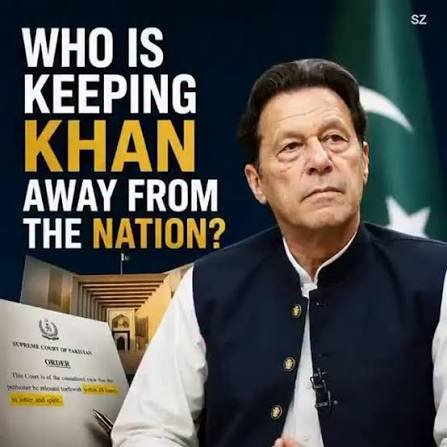
In August 2026, Pakistan’s Supreme Court ordered that Khan be taken to a hospital for medical examination amid concerns about his health, including reported vision problems. The court also allowed family visits and telephone contact with his sons.
On 1 September 2026, a Pakistani high court ordered that Khan and Bushra Bibi should not be kept in solitary confinement and directed that they receive specified access to family visits, phone calls, reading material and necessary medical care.
These developments remain part of an ongoing legal and political story.
THE LEGACY
MORE THAN ONE IDENTITY
Imran Khan’s life cannot be defined by a single profession.
He has been:
A schoolboy cricketer
An Oxford graduate
An international cricket star
A world-class all-rounder
A World Cup-winning captain
A philanthropist
A hospital founder
An education advocate
Founder of PTI
A parliamentarian
Prime Minister of Pakistan
And one of the country’s most influential political figures
His supporters view him as a symbol of political change, accountability and national independence.
His critics have challenged his political decisions, governing record and approach to institutions.
His legal battles have also generated intense debate about Pakistan’s political and judicial system.
Regardless of political opinion, the arc of his life is extraordinary.
THE NUMBERS BEHIND THE LEGACY
🏏 CRICKET
88 — Test matches
175 — ODIs
362 — Test wickets
182 — ODI wickets
3,807 — Test runs
3,709 — ODI runs
1992 — Cricket World Cup victory
ICC inducted Imran Khan into the ICC Cricket Hall of Fame, recognizing his standing as one of the great all-rounders of the game.
🏥 PHILANTHROPY
1994 — Shaukat Khanum Lahore opened
2015 — Shaukat Khanum Peshawar opened
🎓 EDUCATION
2008 — Namal College began operations
2019 — Namal received degree-awarding status
🇵🇰 POLITICS
1996 — PTI founded
2002 — First elected to National Assembly
2013 — PTI became a major national political force
2018 — Elected Prime Minister
2022 — Removed through parliamentary no-confidence vote
THE JOURNEY CONTINUES
Imran Khan’s journey began with cricket, reached its greatest sporting height with Pakistan’s 1992 World Cup triumph, moved into philanthropy through Shaukat Khanum and education through Namal, and eventually transformed into one of the most consequential political careers in modern Pakistan.
His story has included extraordinary victories, personal loss, institutional achievements, political power, confrontation, imprisonment and continuing legal battles.
It is a story that remains unfinished.
From the cricket field to the Prime Minister’s Office — and from political power to imprisonment — Imran Khan’s journey has become inseparable from the story of contemporary Pakistan.